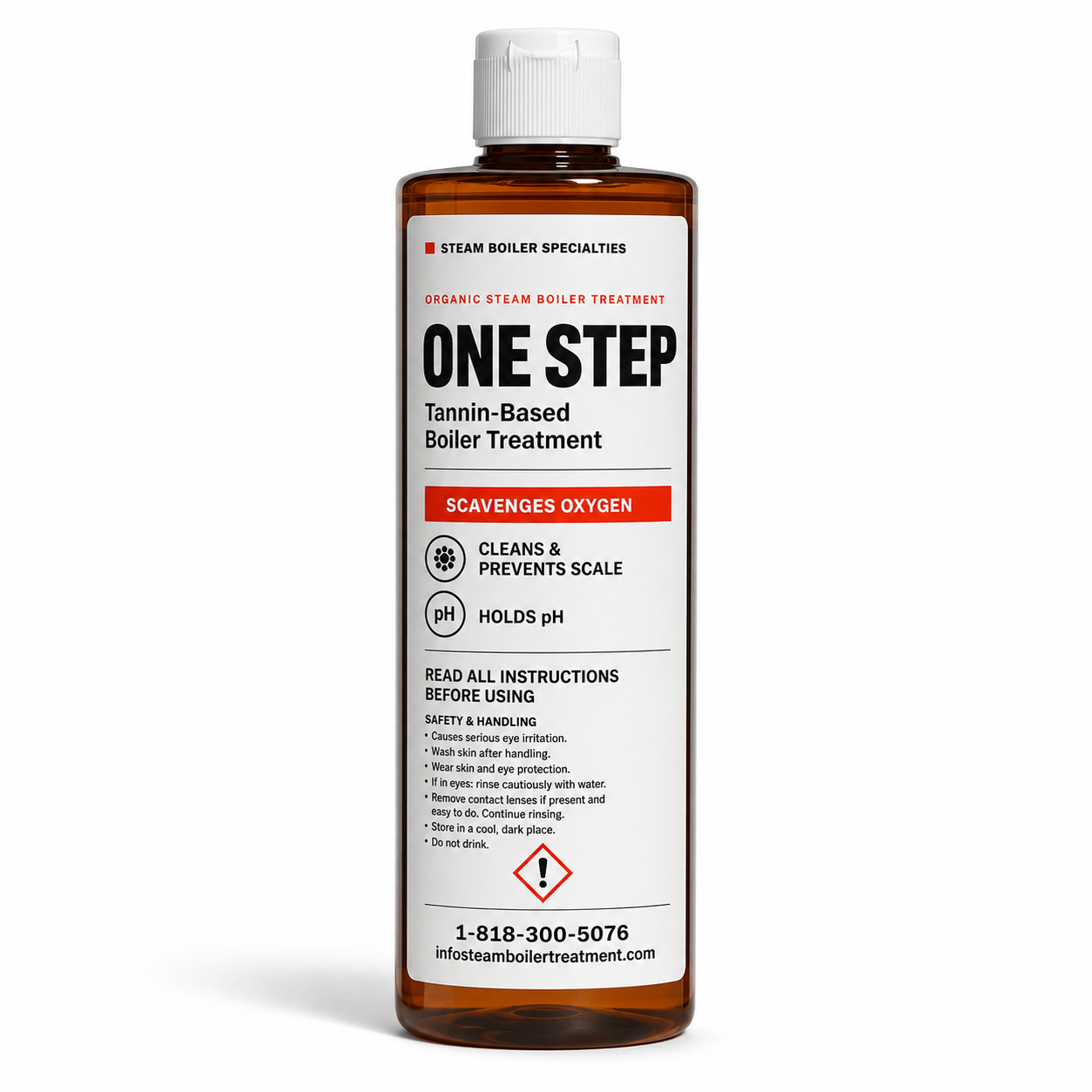
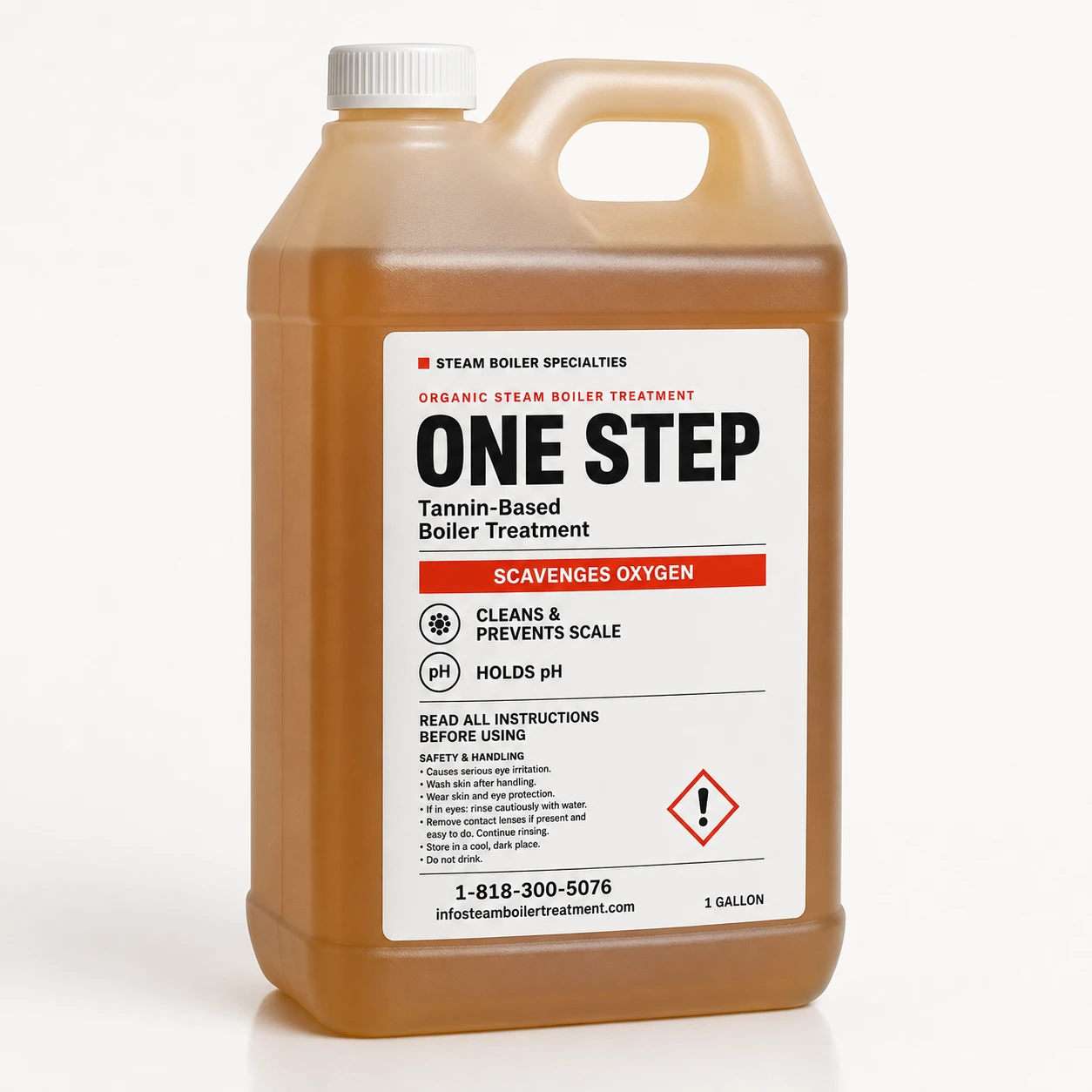
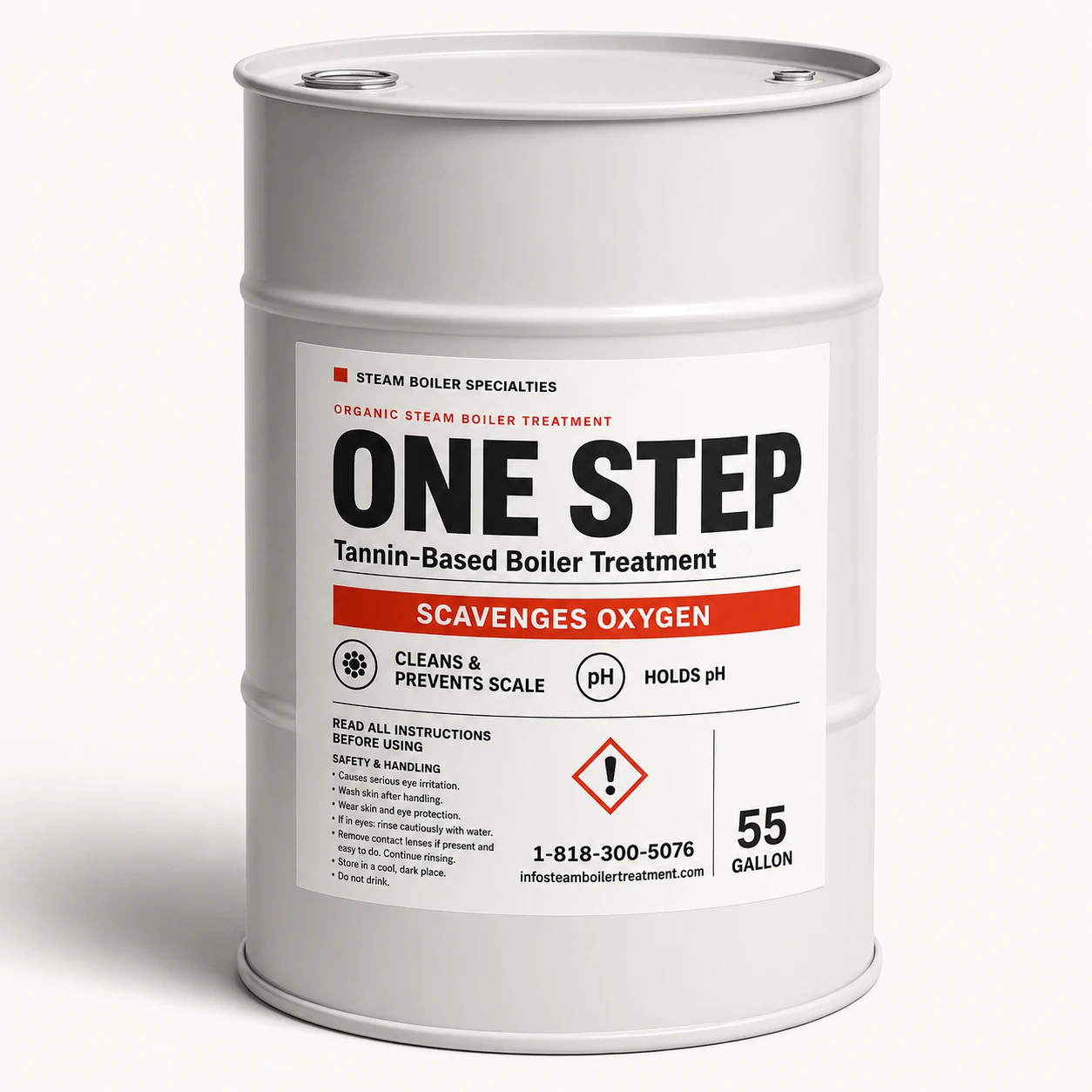
One refined tannin product scavenges oxygen, prevents and dissolves scale, and cuts foaming, replacing the three or four chemicals of a conventional program.
Executive summary
Refined tannin chemistry protects steam boilers against corrosion, scale and carryover with a single, biodegradable product.
Because tannins tolerate far higher dissolved solids than conventional treatments, a boiler can run at much higher cycles of concentration. That means less blowdown, which saves both fuel and water.
Steam Boiler Specialties' ONE STEP treatment is built on this chemistry, and its residual is checked with a simple color-comparison test.
A century of tannins in boiler water
Tannins have been used to treat boiler water since about 1880. Most early treatments have long been replaced, but tannins and phosphates are the exceptions that still hold a place in modern programs.
They have also been widely undervalued, with only a few water treatment companies using them seriously. Environmental pressure is changing that:
- Britain: BS 2486 gave tannins only a passing mention in 1978. Its 1997 revision, retitled Treatment of Water for Steam Boilers and Water Heaters, covers them extensively.
- United States: the ASME 1994 Consensus on Operating Practices for the Control of Feedwater and Boiler Water Chemistry in Modern Industrial Boilers gives detailed control tables but says little about specific chemicals.
What tannins are
Tannins are water-soluble vegetable extracts, usually blended from certain trees. They are related to the lignins and lignosulfonates also used in boiler formulations, and are built mainly on phenolic and sugar molecules.
Synthetic tannins exist but are generally unsuitable for boiler water; natural tannins should be used. Raw tannins come as spray-dried powders or 30–50% liquids, and the viscous 50% liquids need 1–1.5% sterilant to prevent microbial spoilage.
Tannins suit hot-water heating and low-pressure steam boilers, and are generally suitable for industrial and process water-tube boilers up to 650 psig, and in some cases 950 psig.
One molecule, three jobs
A refined tannin attacks all three of a boiler's main problems at once.
Stops corrosion
Tannins scavenge dissolved oxygen, reacting with it to form tropolone and removing the oxygen that drives pitting. They also bond with iron to form a protective iron tannate film on steel.
Prevents and dissolves scale
Through dispersion and chelation, calcium, magnesium and silica stay suspended instead of plating out on tubes, and existing deposits are gradually removed.
Cuts foaming and carryover
Tannins change how boiler water boils: larger bubbles, no foam, drier steam. And because the tannin is non-volatile, it stays in the boiler instead of traveling with the steam.
A thin, dynamic film
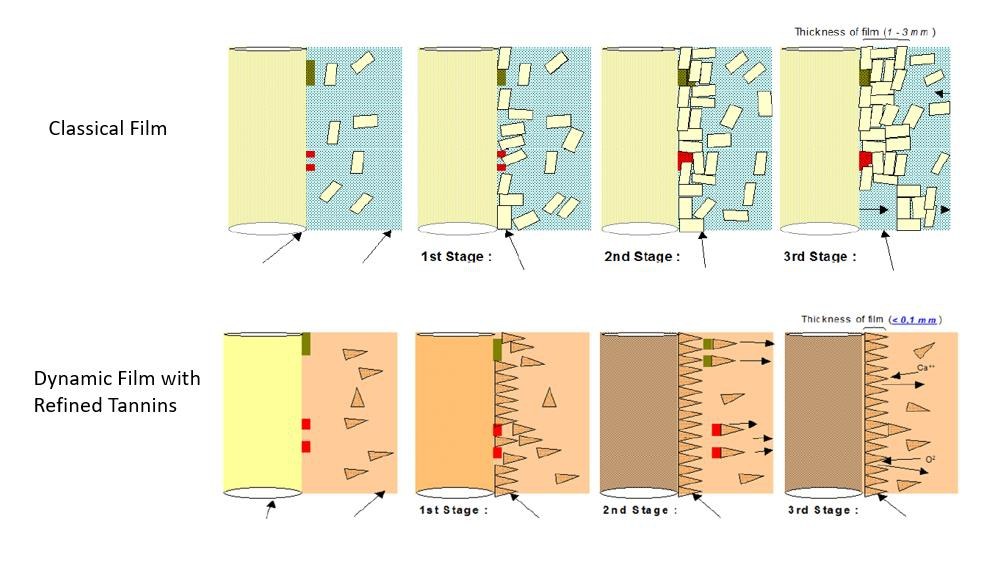
Conventional treatments build a static film that keeps thickening, reaching 1–3 mm. That layer insulates the tubes and cuts heat transfer.
Refined tannins form a dynamic film that constantly adsorbs onto and desorbs from the metal. It stays under 0.1 mm thick, so it protects the steel with no impact on heat exchange, while stabilizing hardness and silica salts and clearing old deposits.
Clean boiling, dry steam
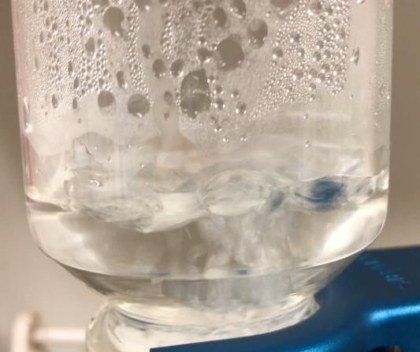
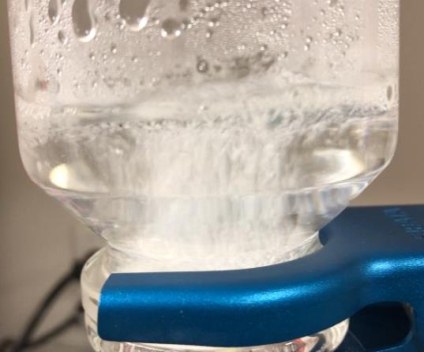
Tannins restore the large-bubble, foam-free boiling of pure water even when dissolved solids are high, which keeps water droplets out of the steam.
Foaming carries water into the steam line. Wet steam holds less usable heat, so reducing carryover improves the thermal efficiency of the whole system.
Refined tannin vs conventional chemistry
Refined tannin chemistry lets a low-pressure boiler run at roughly double the conductivity and up to five times the silica of a conventional program.
| Parameter | Conventional | Refined tannin |
|---|---|---|
| Conductivity, un-neutralized (µS/cm) | under 5,000 | 10,000 (conservative) |
| Silica (ppm SiO₂) | under 150 | 750 (conservative); above 750 with HE softening |
| Total alkalinity (ppm CaCO₃) | under 1,000 | under 3,000 (conservative) |
None of the dangerous chemistry
Tannin treatment is plant-derived, biodegradable and simpler to manage than a multi-chemical program.
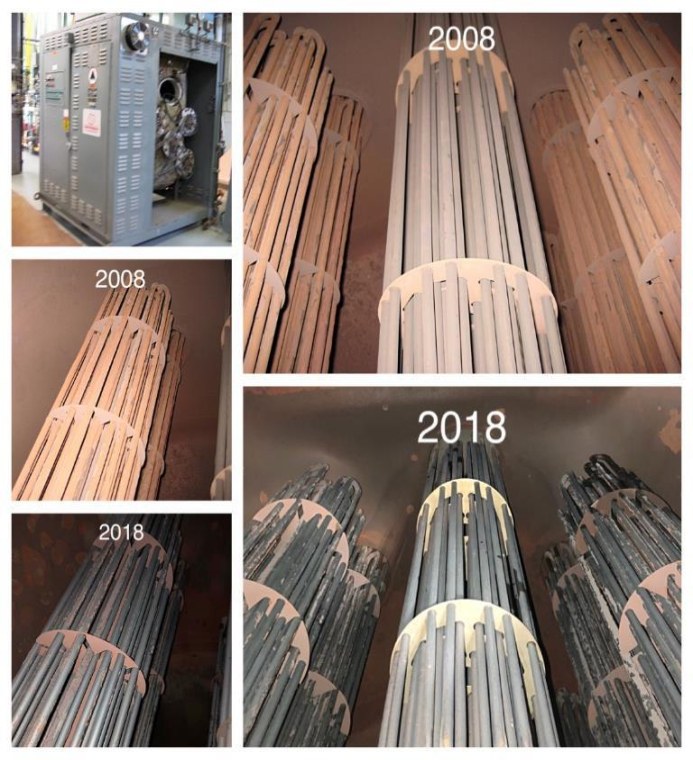
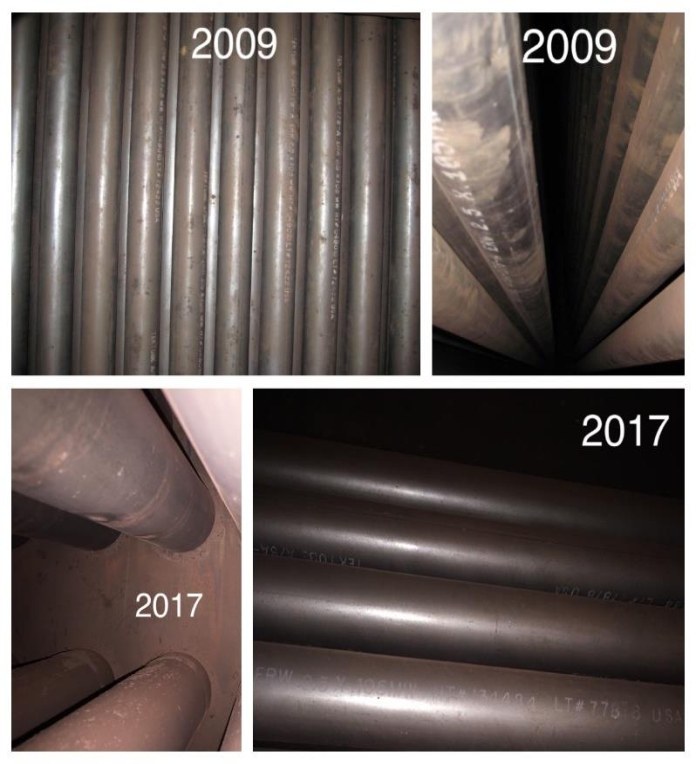
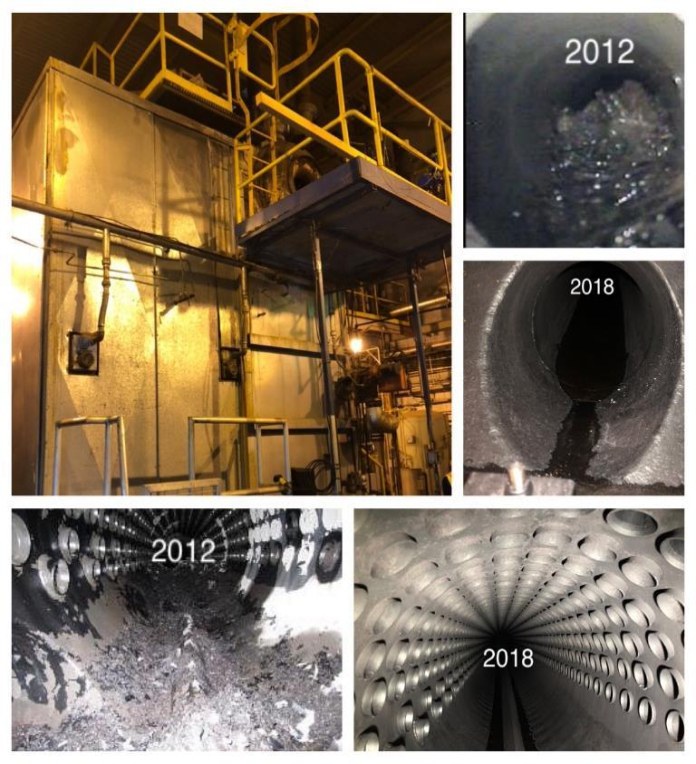
Ten years of clean tubes
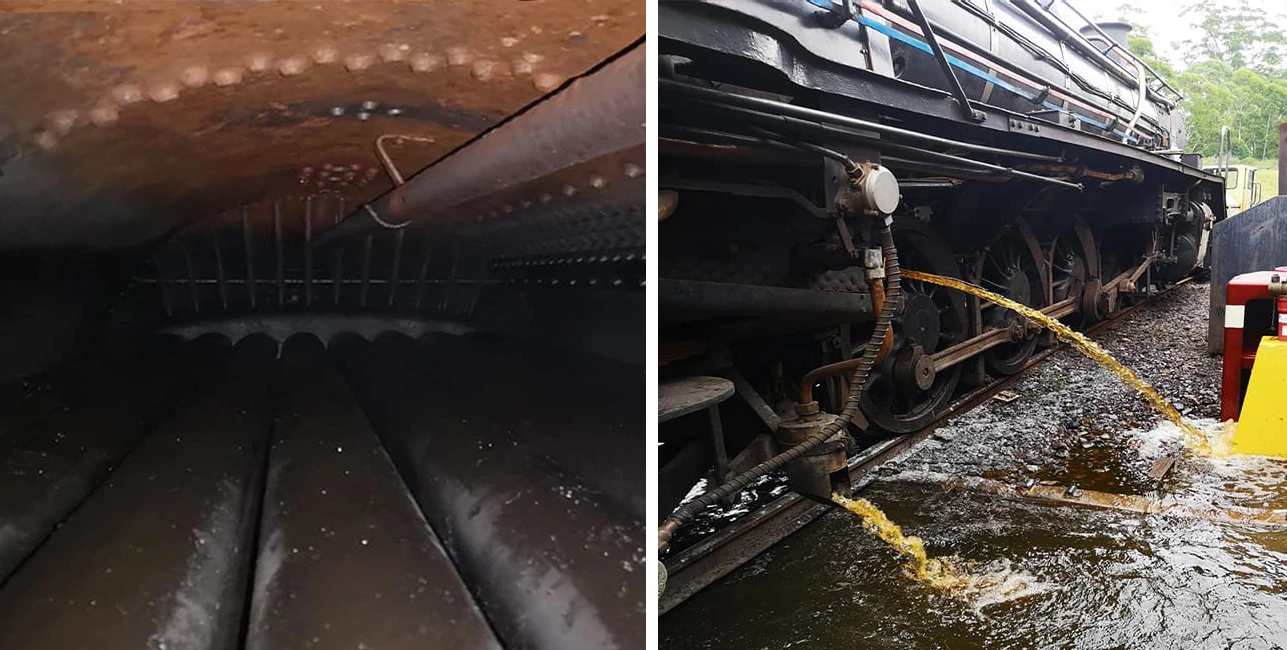
Boilers kept on green tannin chemistry show clean tubes, tube bundles and drums across a decade of inspections, from 2008 through 2018.
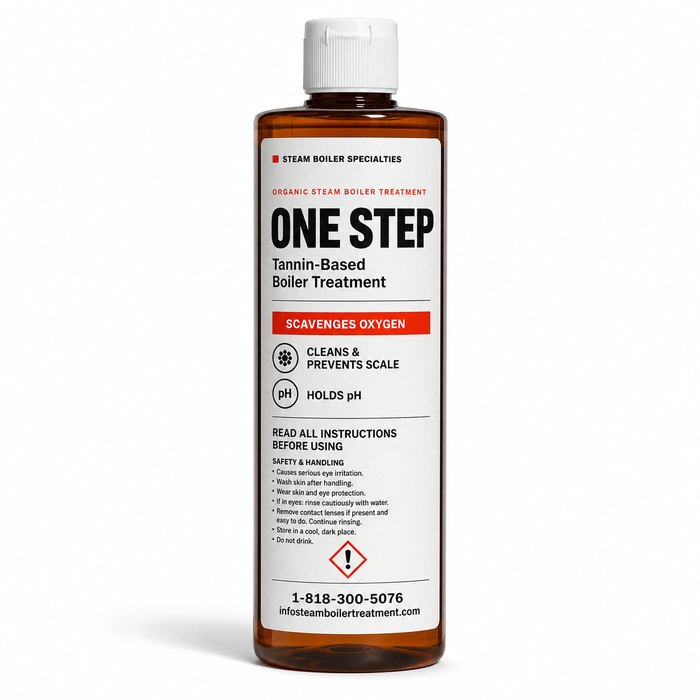
ONE STEP
A proprietary, biodegradable, non-volatile liquid built on refined organic tannins. It handles corrosion, scale and carryover in steel boilers of all sizes with a single product.
ONE STEP combines three active ingredients:
| Ingredient | Role |
|---|---|
| Refined tannins | Oxygen scavenger and corrosion inhibitor; forms the iron tannate film; prevents carryover and foaming |
| Chelant (tetrasodium EDTA) | Keeps calcium and magnesium hardness salts suspended so they don't stick to boiler surfaces; breaks down existing deposits |
| Sodium hydroxide | pH modifier that holds boiler water in the recommended range |
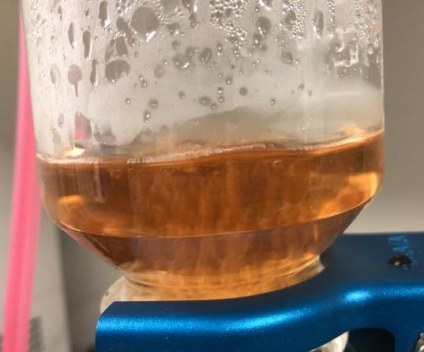
Because ONE STEP is non-volatile, it stays in the boiler at the concentration you dose it to. Expect the water glass to take on a tint once treatment is in the boiler; this is normal.
Dose by color
Start with an initial dose to build the iron tannate film, then adjust to hold about 175–225 ppm tannin.
| System volume | ONE STEP |
|---|---|
| 100 gal | 0.4 gal |
| 500 gal | 2 gal |
| 1,000 gal | 4 gal |
| Scale | Starting amount |
|---|---|
| 1-inch scale | 1/8 oz |
| 1.5-inch, small boiler | 1/4–1/2 oz |
| 1.5-inch, large boiler | 1–1½ oz |
| Larger scales | 2–4 oz |
For models, start at the low end. Adding to the boiler before fire-up is preferred, but dosing through the feedwater tank works as well.
Maintaining the residual
- To raise the concentration, add ONE STEP through the feedwater tank.
- To lower it, blow down the boiler in small increments.
- Recommended maximum conductivity before blowdown: 15,000 µS/cm.
- Make small corrections and let the boiler settle before retesting. Boilers over 20 gallons need larger corrections.
Testing
- Run the boiler for an hour or so and use a few tanks of water before testing.
- Collect a sample safely from the blowdown or water glass drain into a heat-safe cup, and let it cool.
- Fill the 1 oz sample bottle to the very top. It is a calibrated volume, and underfilling changes the color.
- In good light, compare against the color chart and adjust.
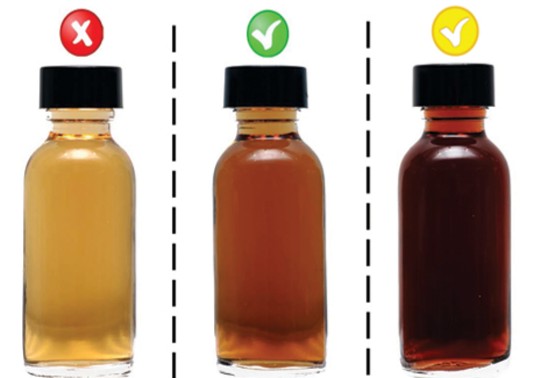
Over time the boiler gets cleaner and needs less product.
Safety and handling
Stop playing chemist. Start running steam.
Refined tannin chemistry has served boilers for more than a century. ONE STEP brings it to every scale, from a 1-inch live steam model to a 1,000-gallon industrial system.